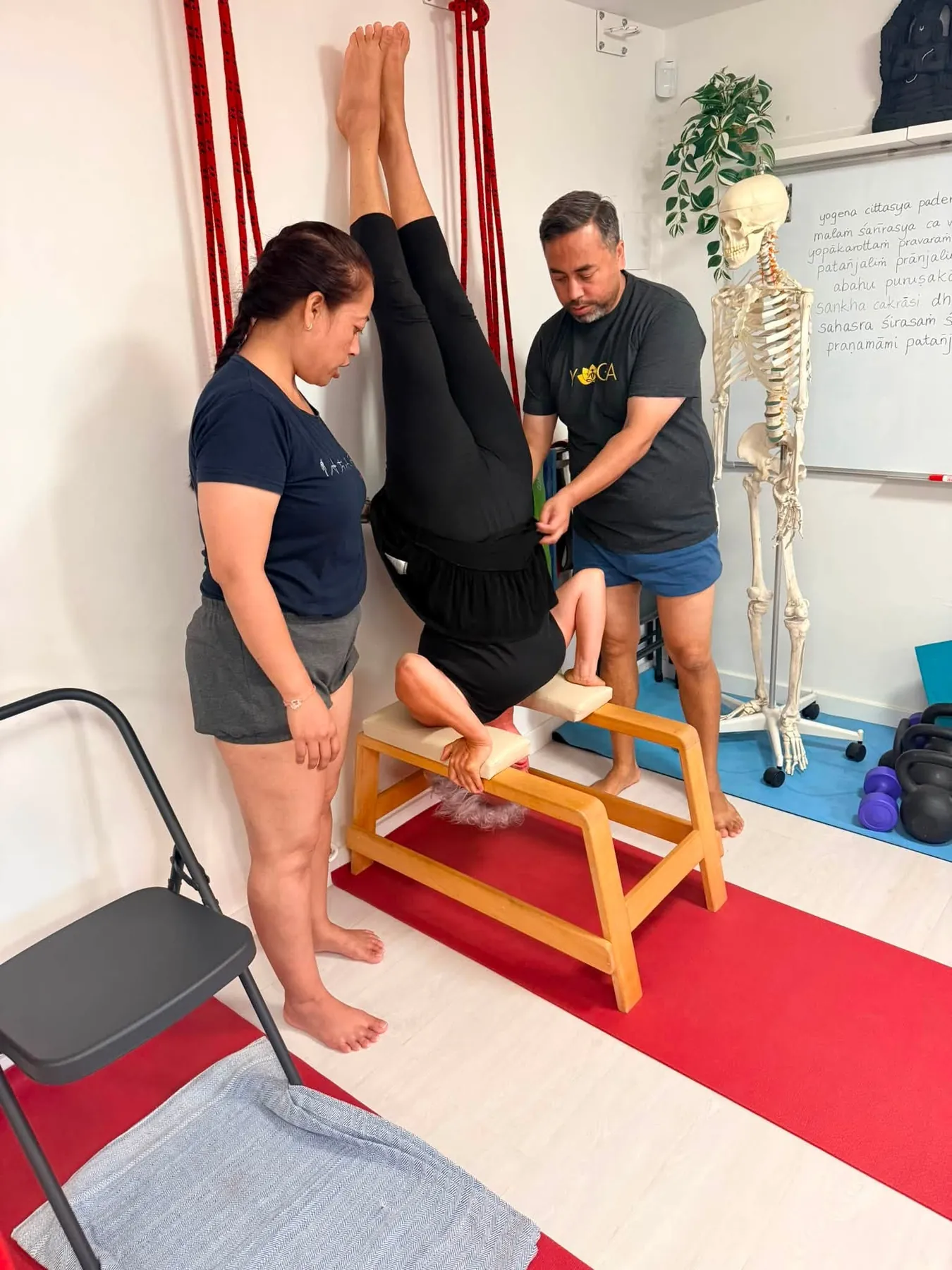
Asanas are one of the major “tools” of Yoga. Their benefits range from the physical level to the spiritual. That is why Yoga is called Sarvanga Sadhana or holistic practice. “Asana” is the positioning of the body in various postures, with the total involvement of the mind and self, in order to establish communication between our external and internal selves. Yogic Philosophy looks at the body as being made up of three layers and five sheaths. The three layers are: the causal body, or Karana Sharira, the subtle body, or Suksma Sharira, and the gross body, or Karya Sharira. Every individual functions in mind, matter, energy, and pure consciousness through five sheaths. These are: the anatomical sheath, or Annamaya Kosha, which is dealt with by Asanas; the life-force sheath or Pranamaya Kosha, which is treated by Pranayama; the psychological sheath, or Manomaya Kosha, is worked on by meditation; and the intellectual sheath, or Vijnanamaya Kosha, is transformed by studying the scriptures with sincerity and discrimination. Once these goals are addressed, you reach the Anandamaya Kosha, or the sheath of bliss. Yoga integrates the three layers of the body with the five sheaths, enabling the individual to develop as a total being. The separation between the body and the mind, and the mind and the soul, then vanishes, as all planes fuse into one. In this way, Asanas help to transform an individual by bringing him or her away from the awareness of the body toward the consciousness of the soul.
The Journey of Yoga
The Hathayoga Pradipika is a practical treatise on Yoga, thought to have been compiled in the 15th century. The author, the sage Svatmarama, gives practical guidelines to beginners on the journey they must make from the culture of the body toward the vision of the soul. Unlike Patanjali, who discusses the sighting of the soul through the restraint of consciousness or Chitta, Svatmarama begins his treatise with the restraint of energy, or Prana. Sighting the soul through the restraint of energy is called Hatha yoga, whereas sighting the soul through the restraint of consciousness is known as Raja Yoga.